
Best HRMS Software in UAE: Features, Benefits and How to Choose the Right Solution
Discover the best AI HRMS software in UAE. Compare essential features, AI-powered HR automation, WPS payroll, attendance and employee management. Request a demo.
Managing employees, payroll, attendance and HR operations can become more complex as a business grows. For companies in the UAE, these responsibilities also involve understanding employment rules, keeping accurate employee records and managing salary payments efficiently.
A Human Resource Management System (HRMS) helps businesses bring these activities together through a digital platform. Rather than relying on spreadsheets, manual approvals and disconnected applications, organisations can automate routine HR processes and improve workforce management.
Choosing the right HRMS software in UAE means looking beyond basic employee records. Businesses should consider payroll management, Wage Protection System (WPS) support, attendance tracking, leave management, employee self-service, reporting and emerging AI-powered capabilities.
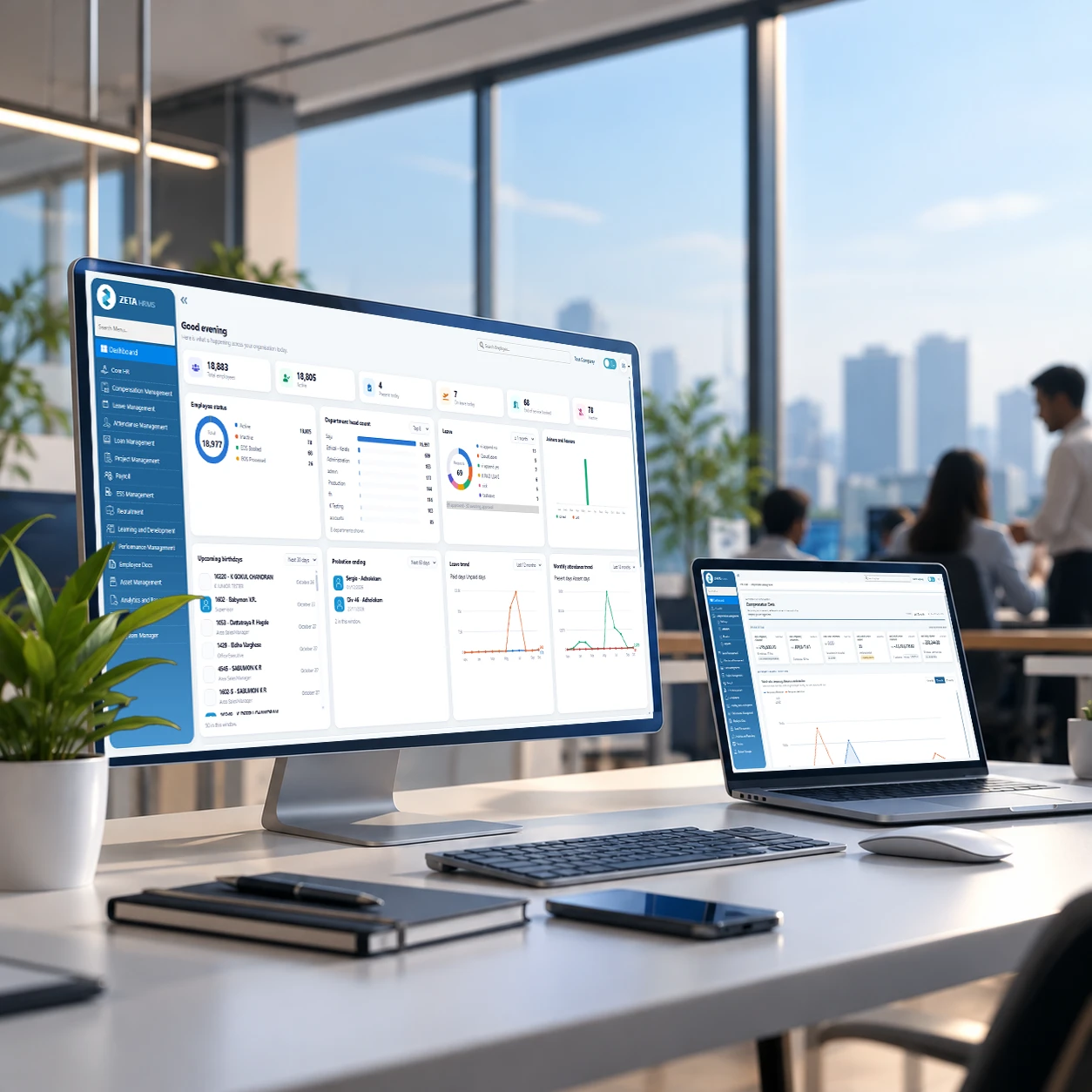
This guide explains the features, benefits and selection criteria to help businesses find the right HRMS solution in the UAE.
AI HRMS Software in UAE: How Artificial Intelligence Is Changing HR
Artificial intelligence is becoming a part of modern HR technology. AI-powered HRMS solutions can help employees access information, simplify interactions and support HR teams with everyday administrative activities.
For businesses exploring AI HRMS software in Dubai, it is worth understanding how AI features work alongside HR management functions.
Important AI Capabilities in HRMS
Depending on the platform, AI-powered HRMS features may include:
- AI-powered HR assistance: HRMS helps employees find answers to HR questions.
- Leave and attendance assistance: HRMS allows employees to check leave balances, holiday calendars and attendance information through conversational interfaces.
- Payslip and salary assistance: HRMS makes salary slips and selected payroll information easier to access.
- Employee self-service automation: HRMS simplifies employee requests and HR interactions.
- HR information access: HRMS helps employees find relevant policies, documents and company announcements.
- Workforce insights: HRMS supports HR teams in analysing workforce information where appropriate analytics capabilities are available.
AI features should complement established HR processes rather than replace the need for accurate employee data, appropriate approvals and human oversight.
Zenita: Zeta's AI-Powered HR Assistant
Zeta's Zenita is an HR assistant integrated with Zeta HRMS. It allows employees to interact with HR services through conversation.
Depending on the configured integration, employees can use Zenita to:
- Apply for or check leave through HRMS
- Access leave balances and holiday information through HRMS
- Check attendance and shift details through HRMS
- Access payslips and selected salary information through HRMS
- Check reimbursement status through HRMS
- Request employee documents through HRMS
- Find answers to HR policy questions through HRMS
- Receive company announcements and notifications through HRMS
Zenita is designed to make everyday HR interactions easier while reducing the need for employees to depend on HR teams for information.
Discover Zeta AI HRMS software and Zenita to learn more about AI-powered employee assistance.
What Is HRMS Software?
HRMS software, or Human Resource Management System software, is a platform that helps organisations manage their employee-related activities from a centralised system.
It connects HR functions, including employee administration, payroll, attendance, leave, recruitment, performance management and employee self-service. With an HRMS, HR teams can reduce repetitive administrative work, maintain organised employee information and make better workforce decisions.
Businesses looking for a solution can explore Zeta HRMS Enterprise, which brings together employee management, compensation, attendance, leave, payroll and other HR capabilities.
Why Do Businesses in the UAE Need HRMS Software?
The UAE has a diverse business environment, with organisations employing people from different countries, managing multiple locations and operating across different industries. As employee numbers increase, managing HR activities manually can lead to delays, inconsistent records and payroll errors.
An HRMS can help UAE businesses address these challenges through centralised employee information and automated workflows. Some important considerations include:
- Payroll administration: HRMS manages salary structures, allowances, deductions and payroll calculations.
- WPS payroll support: HRMS supports the preparation of salary information required for Wage Protection System submissions.
- Employee records: HRMS maintains employee information, documents and employment history.
- Attendance management: HRMS tracks working hours, shifts, overtime and employee attendance.
- Leave administration: HRMS manages leave applications, approvals, balances and company leave policies.
- Employee self-service: HRMS allows employees to access relevant HR information and submit requests digitally.
- Multi-location management: HRMS coordinates HR activities across departments, branches and business entities.
Businesses evaluating solutions can also explore HRMS software in Dubai to understand how HR and payroll systems can support UAE business requirements.
Essential Features of the Best HRMS Software in UAE
The right HRMS must cover the employee lifecycle from onboarding to exit. These features are especially important when comparing HRMS solutions.
1. Employee Information and Core HR Management
Employee information is the foundation of HR management. A centralised employee database helps HR teams keep records and access the information they need. Important capabilities include:
- Employee profiles and personal information
- Employment history and job details
- Department and designation management
- Employee document storage
- Organisation structure management
- Employee transfers and profile updates
- Approval workflows for employee requests
A centralised employee database reduces dependence on spreadsheets and helps HR teams keep records consistent. Explore Zeta HRMS Enterprise to learn more about employee administration and core HR management capabilities.
2. UAE Payroll Management and WPS Support
Payroll is a key function to consider when choosing HRMS software in the UAE. Businesses must calculate salaries accurately while managing allowances, deductions, overtime, leave-related payments and other salary components. A suitable payroll system should support:
- Automated salary calculations
- Salary structures
- Allowances and deductions
- Overtime and arrears processing
- Payroll reports and payslips
- Final settlement calculations
- Payroll approval workflows
- WPS-related salary file preparation, where supported
The UAE Wage Protection System is a consideration for employers covered by the applicable requirements. Businesses should verify that their chosen payroll solution supports the salary information and file preparation processes.
Zeta offers WPS-ready HRMS and payroll software for UAE businesses with support for Salary Information File (SIF) generation. You can also explore Zeta payroll management software for information about payroll capabilities.
3. Attendance and Time Management
Accurate attendance records help businesses manage working hours, shifts, overtime and employee availability. Manual attendance tracking can become difficult when organisations have several departments, branches or shift-based employees. Look for HRMS software that offers:
- Employee clock-in and clock-out records
- Shift and roster management
- Biometric attendance integration, where supported
- Overtime tracking
- Attendance reports
- Late arrival and early departure records
- Attendance approval workflows
An integrated attendance system can also help reduce payroll discrepancies by linking employee working-hour information with payroll processing.
4. Leave and Absence Management
Managing leave manually can create administrative work, especially when organisations have different leave policies and approval levels. An HRMS with leave management capabilities lets employees submit requests while managers and HR teams review and approve them through defined workflows. Useful features include:
- Online leave applications
- Leave balance tracking
- Leave eligibility rules
- Leave approval workflows
- Holiday calendar management
- Leave history and reports
- Leave encashment support, where applicable
Businesses should configure leave policies according to the employment rules, employee categories and internal policies.
5. Employee Self-Service (ESS) Portal
Employee Self-Service gives employees access to selected HR services without requiring HR teams to handle every routine request. Through an ESS mobile application, employees may be able to:
- View and update permitted personal information
- Access payslips
- Check leave balances
- Apply for leave
- View attendance records
- Submit employee requests
- Access company announcements and documents
ESS improves communication between employees, managers and HR departments while reducing administrative tasks.
6. Recruitment and Onboarding Management
Recruitment and onboarding are parts of the employee lifecycle. A structured HRMS helps businesses organise candidate information and manage the transition from recruitment to employment. Depending on the system, recruitment and onboarding capabilities may include:
- Candidate information management
- Recruitment workflows
- Employee enrolment
- Document collection
- Joining formalities
- Probation tracking
- Employee record creation
Connecting recruitment with core HR helps reduce repeated data entry and makes employee onboarding more organised.
7. Performance Management
Employee performance management helps organisations monitor team progress against business objectives. An HRMS may support:
- Performance evaluation workflows
- Goal and target management
- Employee assessments
- Manager feedback
- Performance history
- Evaluation reports
These capabilities help HR teams organise performance reviews and support employee development.
8. HR Analytics and Reporting
HR data can provide insights into workforce trends and operational performance. A good HRMS should provide reporting capabilities that help HR managers understand employee information and identify areas requiring attention. Useful reports may include:
- Employee headcount
- Attendance summaries
- Leave utilisation
- Payroll summaries
- Employee turnover
- Department-wise workforce information
- Performance reports
Reporting requirements differ for each organisation, so businesses must check whether the system provides standard reports and custom reporting options.
UAE HRMS Compliance: What Should Businesses Consider?
HRMS software can help businesses organise employee records, payroll information and HR workflows. However, using software does not automatically guarantee legal compliance. Businesses must configure HRMS systems according to the rules that apply to their employees and operations. When evaluating HRMS software in the UAE, consider the following areas.
Wage Protection System (WPS)
The Wage Protection System is an electronic salary transfer framework that applies to covered private-sector employers. Businesses should check if their payroll system supports the required salary information and the relevant file preparation processes. Learn more about Zeta's WPS-ready HRMS software in UAE.
UAE Labour Law and Employment Records
Businesses should keep employee information and manage employment-related processes in line with applicable UAE labour requirements. An HRMS can help organise employment records, contracts, employee documents, leave information and payroll history.
Leave and End-of-Service Benefits
Leave entitlements and end-of-service benefits should be handled according to the employment rules and employee circumstances. Businesses should verify that their HRMS can accommodate the required calculations, policies and approval processes.
DIFC and ADGM Considerations
Businesses operating in the Dubai International Financial Centre (DIFC) or Abu Dhabi Global Market (ADGM) should consider the employment regulations that apply to their jurisdiction.
Do not assume that the same employment rules apply to every organisation in the UAE. Confirm the requirements before configuring HRMS policies.
Benefits of Using HRMS Software in UAE
Implementing an HRMS can improve the efficiency of HR operations and employee administration.
1. Reduced Manual Work
Automating routine activities such as leave approvals, attendance processing and employee requests reduces administrative tasks.
2. More Organised Payroll Processing
Integrated payroll capabilities help HR and finance teams manage salary information, allowances, deductions and payroll reports from one system.
3. Improved Employee Experience
ESS portals and AI-powered HR assistants give employees access to HR services and information.
4. Better Employee Data Management
Centralised employee records make it easier to maintain and retrieve information while supporting HR processes.
5. Improved HR Visibility
Reports and dashboards help HR managers understand workforce information and monitor HR activities.
6. Support for Business Growth
An HRMS can help businesses manage increasing employee numbers, additional branches and more complex approval structures.
Cloud-Based HRMS Software vs On-Premise HRMS Software
Businesses evaluating HRMS solutions should also consider the deployment model.
| Consideration | Cloud-based HRMS | On-premise HRMS |
|---|---|---|
| Accessibility | Access through supported internet-connected devices | Access depends on the organisation's infrastructure and configuration |
| Infrastructure | Hosting is managed through the cloud service arrangement | Organisation manages or arranges its infrastructure |
| Maintenance | Updates and maintenance are generally handled by the provider | Organisation has greater responsibility for infrastructure maintenance |
| Scalability | Can offer flexible scaling depending on the service plan | Scaling may require additional infrastructure |
| Control | Depends on the provider's platform and configuration | Greater direct control over the hosting environment |
The right option depends on an organisation's IT resources, security requirements, budget and operational preferences. Businesses should review hosting arrangements, data protection, backup policies, access controls and service-level commitments before making a decision.
Why Consider Zeta HRMS Software for Your UAE Business?
Zeta Softwares has been developing and marketing ERP and HRMS solutions since 1998. Its software supports businesses across regions and industries, helping organisations manage HR and business operations through integrated digital systems.
Zeta HRMS offers capabilities across HR functions, including:
- Employee administration and HR management
- Compensation and payroll management
- Leave management
- Time and attendance management
- Employee Self-Service (ESS)
- Recruitment management
- Performance management
- Employee documents and workflows
- Business intelligence, analytics and reporting
For UAE businesses, relevant capabilities include WPS-related payroll support, employee management and configurable HR workflows. Zeta also offers Zenita, an AI-powered HR assistant designed to make everyday HR interactions more accessible.
Explore the following solutions:
- Zeta HRMS Software in Dubai
- Zeta HRMS Enterprise
- Zeta Payroll Management Software
- Zeta WPS-Ready HRMS Software UAE
- Zeta AI HRMS Software – Zenita
Businesses can check the modules and deployment choices that fit their staff size, day-to-day needs and future plans.
Related reading: why UAE businesses are switching to cloud HRMS and why GCC HRMS compliance matters.
Frequently Asked Questions About HRMS Software in UAE
What is HRMS software?
HRMS (Human Resource Management System) software is a digital platform that helps organisations manage employee-related activities from a centralised system, connecting employee administration, payroll, attendance, leave, recruitment, performance management and employee self-service.
What is AI HRMS software?
AI HRMS software adds artificial intelligence features to HR management, such as conversational HR assistance, leave and attendance enquiries, payslip access, employee self-service automation and workforce insights. These features complement established HR processes rather than replacing accurate employee data, appropriate approvals and human oversight.
What features should the best HRMS software in UAE include?
Look for core HR and employee records, UAE payroll with WPS support, attendance and time management, leave management, an employee self-service (ESS) portal, recruitment and onboarding, performance management, and HR analytics and reporting.
Does Zeta HRMS support the UAE Wage Protection System (WPS)?
Yes. Zeta provides WPS-ready HRMS and payroll software for UAE businesses, including support for Salary Information File (SIF) generation.
Does using HRMS software guarantee compliance with UAE labour law?
No. HRMS software helps organise employee records, payroll information and HR workflows, but software alone does not guarantee legal compliance. Businesses must configure their systems according to the rules that apply to their employees and operations, including any DIFC or ADGM employment regulations.
Should I choose cloud-based or on-premise HRMS software?
It depends on your organisation's IT resources, security requirements, budget and operational preferences. Before deciding, review hosting arrangements, data protection, backup policies, access controls and service-level commitments.
What is Zenita?
Zenita is Zeta's AI-powered HR assistant, integrated with Zeta HRMS. Depending on the configured integration, employees can use it to apply for or check leave, view attendance details, access payslips and find answers to HR policy questions.